
Construction Materials
Concrete Calculator
Calculate the concrete needed for a slab, footing, column or set of post holes. Results include cubic yards for ready-mix delivery, the number of pre-mixed bags for smaller pours, and an estimated cost.
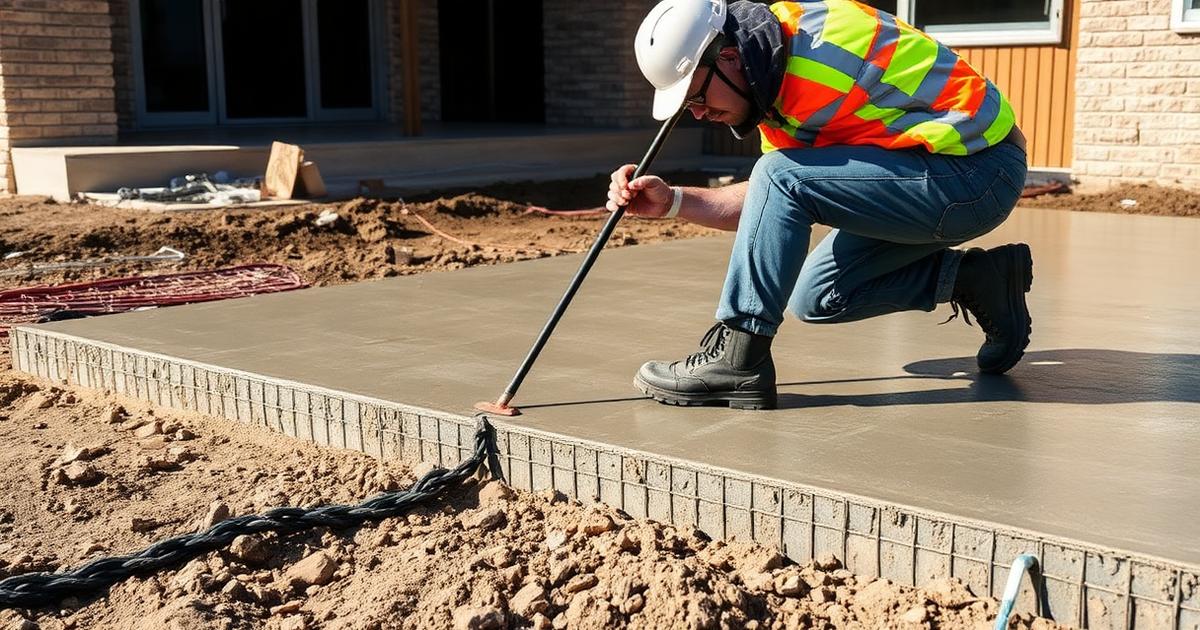
How much concrete do I need for a slab?
Multiply length × width × thickness in feet to get cubic feet, then divide by 27 for cubic yards. A 20 ft × 12 ft patio at 4 inches thick is 80 ft³ — 88 ft³ (about 3.26 yd³) once a 10% waste allowance is added. Ready-mix is sold by the cubic yard and usually rounded up to a supplier increment; small pours under about one yard often carry a short-load fee.
Key takeaways
- Volume equals area times thickness — get the thickness right in feet, since a decimal error there scales the whole result.
- Ready-mix is priced and delivered by the cubic yard; bagged mix is priced and yields by the bag.
- Short-load fees (common below about one cubic yard) often make bagged mix the practical option for small pours.
- A 5-10% waste allowance covers subgrade irregularity and spillage, and prevents a cold joint from running short mid-pour.
- Reinforcement, formwork and subgrade prep are separate line items this calculator does not price.
Enter your details
Estimated result
Concrete needed
3.2593 cubic yards
88 ft³ including a 10% waste allowance
- Ready-mix order (rounded up)
- 3.5 yd³
- 80 lb bags
- 147
Volume breakdown (cubic feet)
Volume breakdown (cubic feet) chart. Base volume: 80 ft³, 91 percent. Waste allowance: 8 ft³, 9 percent.
Largest share
91%
Volume
- Base volume
- 80 ft³
- Waste allowance
- 8 ft³
- Total volume
- 88 ft³
Same total in other units
- Cubic yards
- 3.2593 yd³
- Cubic meters
- 2.492 m³
- Before waste
- 2.963 yd³
Ordering comparison
- Ready-mix orderEstimated volume rounded up to the nearest 0.5 yd³
- 3.5 yd³
- Rounded-order material costOrder quantity × price per yard; used for the comparison
- $560.00
- Estimated-volume material costExact volume × price per yard, for reference
- $521.48
- Bagged mix (80 lb bags)
- 147
- Bagged mix material cost
- $882.00
- Lower material cost
- Ready-mix
- Material cost only. Supplier charges may differ: delivery, short-load fees (common under about 1 yd³), pumping, weekend surcharges and taxes are not included.
- Bag yields vary by manufacturer and product — use the yield printed on the bag you plan to buy.
Your result is an estimate based on the information entered.
Calculated in your browser
This calculator runs locally; your exact figures are not sent to our servers. Anonymous usage events (calculator name, field names, rounded value ranges) are recorded by Google Analytics — see the privacy policy.
HomeCalc USA — Concrete Calculator
Generated
Inputs
- What are you pouring?: Slab, patio or footing (rectangular)
- Length: 20
- Length unit: Feet
- Width: 12
- Width unit: Feet
- Thickness / depth: 4
- Thickness unit: Inches
- Waste allowance: 10
- Bag size (for bagged mix): 80 lb bag (0.60 ft³)
- Supplier rounds orders up to: Nearest 1/2 cubic yard
- Ready-mix price per cubic yard: 160
- Price per bag: 6
Results
Concrete needed: 3.2593 cubic yards
- Base volume: 80 ft³
- Waste allowance: 8 ft³
- Total volume: 88 ft³
- Cubic yards: 3.2593 yd³
- Cubic meters: 2.492 m³
- Before waste: 2.963 yd³
- Ready-mix order: 3.5 yd³
- Rounded-order material cost: $560.00
- Estimated-volume material cost: $521.48
- Bagged mix (80 lb bags): 147
- Bagged mix material cost: $882.00
- Lower material cost: Ready-mix
Assumptions
- The pour has a uniform thickness across the whole area.
- Default bag yields are typical published figures (e.g. 0.60 ft³ per 80 lb bag); actual yields vary by manufacturer and can be entered manually.
- Ready-mix orders are rounded up to the increment you select; material cost excludes delivery and fees.
- Bag counts are rounded up to whole bags.
- Prices entered are per cubic yard delivered or per bag at the store.
Estimates are for informational purposes only and may differ from actual costs, lender offers, tax assessments or contractor quotes.
What your result means
The headline volume already includes your waste allowance and is shown in the units concrete is actually sold in: cubic yards for ready-mix trucks and whole bags for bagged mix. The calculator prices both so you can compare a ready-mix quote against a hardware-store bag price for the same job.
How to use this calculator
Choose the shape first. Rectangular covers slabs, patios, sidewalks, driveways and strip footings. Round covers post holes, sonotube columns and pier footings, where you enter a diameter and the number of identical holes.
Enter the finished thickness as depth. Common thicknesses are 4 inches for a patio or sidewalk, 5-6 inches for a driveway carrying vehicles, and deeper for footings, which are also governed by local frost depth requirements.
Keep a waste allowance in place. Subgrade is never perfectly level, and running out mid-pour creates a cold joint that weakens the slab. For irregular slabs, break the area into rectangles and add the results.
What each input means
| Input | What it means |
|---|---|
| Shape | Rectangular covers slabs, patios, sidewalks and strip footings; round covers post holes and sonotube columns. |
| Length / width or diameter | Footprint dimensions in plan view; diameter is the full width of a round hole or column. |
| Thickness / depth | Finished slab thickness or hole depth, not including formwork or gravel base beneath it. |
| Waste allowance | Extra volume for uneven subgrade, over-excavation and spillage during placement. |
| Bag size | Sets the published cubic-foot yield used to convert total volume into a bag count. |
Formula used
Rectangular pours:
Volume (ft³) = length (ft) × width (ft) × thickness (ft)
Round pours, where r is half the diameter in feet:
Volume (ft³) = π × r² × depth (ft) × number of holes
Cubic yards = cubic feet ÷ 27
Bag counts use the published yield of each bag size — roughly 0.60 ft³ for an 80 lb bag, 0.45 ft³ for 60 lb, 0.375 ft³ for 50 lb and 0.30 ft³ for 40 lb — and are always rounded up:
Bags = ⌈ total cubic feet ÷ yield per bag ⌉
Worked example
A 20 ft × 12 ft patio at 4 inches thick (4 ÷ 12 = 0.3333 ft):
20 × 12 × 0.3333 = 80 ft³
A 10% waste allowance adds 8 ft³:
88 ft³ ÷ 27 ≈ 3.2593 yd³
At $160 per cubic yard:
- Estimated-volume material cost: 3.2593 × $160 ≈ $521.48
- Rounded-order material cost: a supplier selling in half-yard steps delivers 3.5 yd³, so 3.5 × $160 = $560
The rounded-order figure is what you compare against bags, because it is what you pay for. With 80 lb bags yielding 0.60 ft³, the same pour needs ⌈88 ÷ 0.60⌉ = 147 bags — $882 at $6 a bag, before the labor of mixing them. Your supplier's actual charges may differ.
Six round post holes, each 12 inches in diameter (r = 0.5 ft) and 3 ft deep:
π × 0.5² × 3 × 6 ≈ 14.137 ft³ ≈ 0.5236 yd³ before waste
That is slightly more than half a cubic yard. With 10% waste it becomes about 15.55 ft³ (0.5760 yd³), or 26 eighty-pound bags at 0.60 ft³ each. Because many ready-mix suppliers add a short-load fee below about one cubic yard, bagged mix is often more practical at this size — confirm the fee with your supplier.
How many bags of concrete equal a cubic yard?
An 80 lb bag yields about 0.60 ft³, and a cubic yard is 27 ft³, so it takes roughly 45 bags — about 3,600 lb of dry mix — to equal one yard. That weight and the mixing labor involved is why most jobs above half a yard order ready-mix instead.
What is a short-load fee?
Ready-mix plants size their trucks for large pours, so many charge an extra fee — often $50-$150 — for deliveries under one cubic yard, sometimes scaled per yard short of a minimum. Always ask for the short-load threshold and fee before ordering a small quantity.
Do I need rebar or wire mesh in a slab?
Most driveway and structural slabs use reinforcement — rebar grids or welded wire mesh — to control cracking and carry load. Thin decorative slabs may use fiber-reinforced mix instead. Reinforcement type and spacing should follow local code or an engineer's specification, since this calculator only estimates volume.
Factors that change the result
- Slab thickness
- Patios and sidewalks are commonly 4 inches; driveways carrying vehicles typically need 5-6 inches to resist cracking under load.
- Subgrade preparation
- A compacted gravel base and properly graded subgrade reduce settling cracks and are usually required before pouring, though not included in the volume estimate.
- Reinforcement
- Rebar grids, welded wire mesh or fiber additives control cracking; the type used does not change the concrete volume but is a required part of most structural pours.
- Formwork
- Wood or metal forms hold the pour to its shape until it cures; sizing and bracing depend on slab thickness and site conditions.
- Weather and cure time
- Concrete needs several days of proper curing temperature and moisture; hot, dry or freezing conditions change the mix design and finishing schedule, not the ordered volume.
- Frost depth for footings
- In cold climates, footings must extend below the local frost line to prevent heaving, which affects the depth entered even though it is set by code, not by preference.
Common mistakes to avoid
Forgetting to convert thickness to feet
A 4 inch slab is 0.333 ft, not 4 ft — entering the raw inch value without conversion inflates the volume twelvefold if done manually outside the calculator.
Ordering the exact calculated volume with no waste allowance
Running short mid-pour forces a second delivery and creates a cold joint, a visible and structurally weaker seam between old and new concrete.
Assuming ready-mix is always cheaper
Short-load fees on deliveries under about a cubic yard can make bagged mix the better value for small jobs like a single footing or step.
Skipping reinforcement on load-bearing slabs
A driveway or garage slab without rebar or mesh is more prone to cracking under vehicle weight, even if the volume of concrete is otherwise sufficient.
Not checking local frost depth for footings
A footing poured shallower than the local frost line can heave and crack over winter freeze-thaw cycles.
Practical tips
- Break irregular slabs into rectangles, run the calculator for each, and add the cubic yard totals together.
- Call the ready-mix plant before ordering small quantities to confirm their short-load fee and minimum order.
- Order slightly more than the bare calculation, especially for a first-time DIY pour where placement is slower.
- Keep the subgrade compacted and level before form-setting; wasted concrete filling low spots adds up fast on an uneven base.
- For post holes, add extra depth below the frost line in cold climates rather than relying on diameter alone.
When the estimate may differ from reality
Actual concrete used can differ from this estimate if the subgrade is uneven, forms bow during the pour, or the ready-mix truck delivers a partial load. Reinforcement, formwork, gravel base, vapor barriers and finishing labor are priced separately by contractors and are not included in this volume-based estimate.
Assumptions and limitations
What this calculator assumes
- The pour has a uniform thickness across the whole area.
- Default bag yields are typical published figures (e.g. 0.60 ft³ per 80 lb bag); actual yields vary by manufacturer and can be entered manually.
- Ready-mix orders are rounded up to the increment you select; material cost excludes delivery and fees.
- Bag counts are rounded up to whole bags.
- Prices entered are per cubic yard delivered or per bag at the store.
What it does not account for
- Reinforcement — rebar, wire mesh and fibre additives.
- Formwork, gravel sub-base, vapour barrier and expansion joints.
- Short-load fees, pump truck hire, weekend delivery surcharges and finishing labour.
- Structural design requirements, which should come from local code or an engineer.
Frequently asked questions
- How many 80 lb bags of concrete are in a cubic yard?
- An 80 lb bag yields about 0.60 cubic feet, and a cubic yard is 27 cubic feet, so it takes roughly 45 bags. That is around 3,600 lb of material, which is why ready-mix is usually the practical choice above about half a yard.
- How thick should a concrete slab be?
- Patios and sidewalks are commonly 4 inches thick. Driveways and slabs supporting vehicles are usually 5 to 6 inches, often with reinforcement. Footings depend on the load and on local frost depth, so check your building code.
- How much extra concrete should I order?
- Typically 5 to 10%. Subgrade variation alone can consume several percent, and a pour that runs short must be completed later, creating a weak cold joint. Ordering slightly over is far less costly than a second delivery.
- Is ready-mix or bagged concrete cheaper?
- Ready-mix is generally cheaper per unit volume once you pass roughly half a cubic yard, but suppliers add short-load fees for small deliveries. The calculator prices both so you can compare using your own local quotes.
- How is a cubic yard of concrete ordered?
- Ready-mix plants dispatch trucks by the cubic yard, usually rounded up to the nearest quarter or half yard, and often require the order to be placed a day in advance so the batch can be mixed and scheduled for delivery.
- Do I need formwork before pouring?
- Yes, for any slab, footing or column above grade. Wood or metal forms hold the wet concrete to the intended shape and dimensions until it sets enough to hold its own shape, typically 24 to 48 hours.
- What is a cold joint and how do I avoid one?
- A cold joint forms when fresh concrete is placed against concrete that has already begun to set, creating a visible seam that is weaker than a continuous pour. Ordering enough material up front, including a waste allowance, is the simplest way to avoid one.
- How deep should a fence post footing be?
- Depth depends on post height, soil type and local frost line, but a common guideline is roughly one-third to one-half the post's above-ground height, and always below the frost depth in cold climates to prevent heaving.
Sources and references
- Quikrete — concrete mix yields and project calculator — Manufacturer yield figures for bagged concrete.
- Sakrete — concrete mix product data — Bag yields differ by product; check the data sheet.
- NRMCA — Concrete in Practice series — Ready-mixed concrete industry technical briefs.
- ACI / concrete.org — Technical background on concrete practice and standards.
Related guides
- How Much Gravel Do I Need?Convert length, width and depth into cubic yards and tons of gravel, choose a realistic depth, and understand why tonnage varies by product.
- How Much Concrete Do I Need?Calculate concrete for slabs, footings and post holes in cubic yards, with two worked examples, mix strength guidance and ready-mix ordering tips.
Related calculators
- Gravel CalculatorEstimate gravel volume in cubic yards and weight in tons for driveways, paths and beds.
- Flooring CalculatorWork out square footage and how many boxes of flooring to order, including waste.
- Home Renovation Cost CalculatorBuild a transparent renovation budget from your own material, labor and contingency inputs.
- Paint CalculatorEstimate paintable wall area and how many gallons of paint your project needs.